
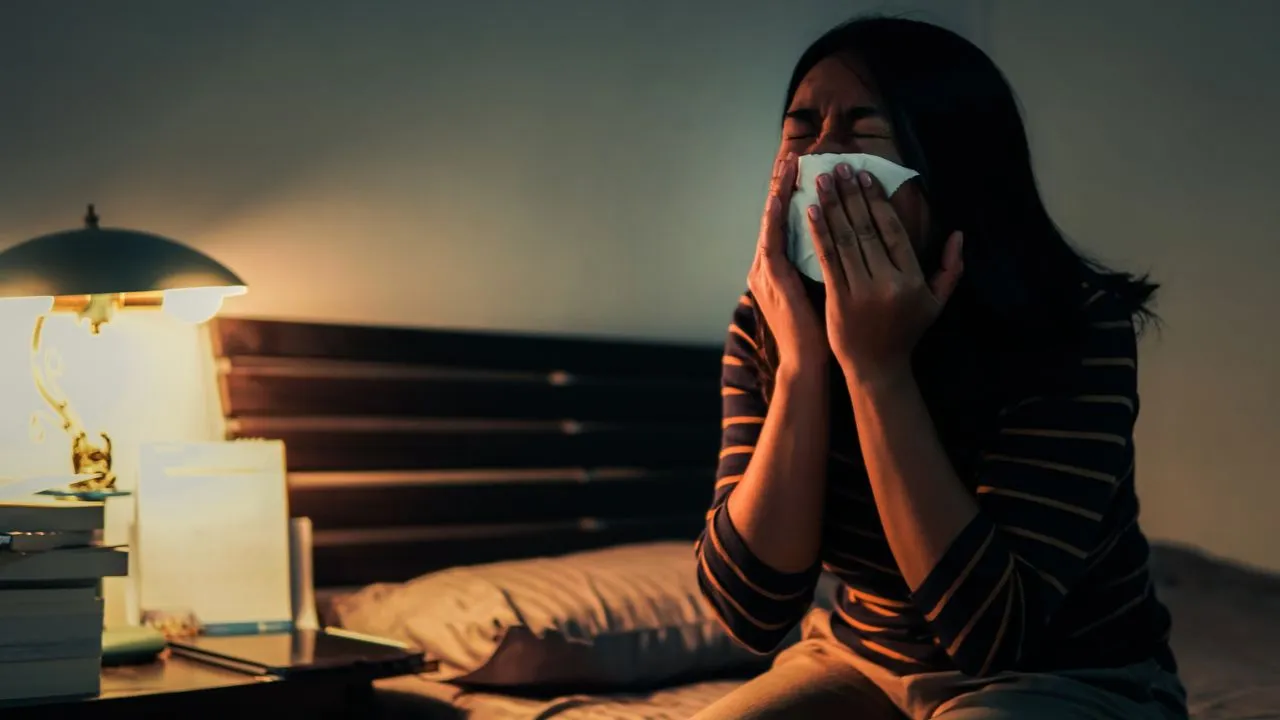
You feel fine all day. Then you lie down, and your nose stops working. The sneezing starts. Your eyes itch. You cough until your chest hurts. By morning, you are exhausted and congested, wondering what changed between dinner and bedtime.
The answer is not in your head. Seasonal allergies genuinely do get worse at night for most people. The reasons stack on top of each other: your body’s internal clock, gravity, the allergens hiding in your bedroom, and the way your immune system behaves after sunset. Understanding each one gives you a real path to sleeping through the night again.
Your Body’s Clock Is Working Against You After Dark
Every cell in your body follows a roughly twenty-four-hour schedule. This internal timing system controls when you feel sleepy, when you feel hungry, and, crucially for allergy sufferers, when your immune system is most reactive.
Research on the circadian clock has shown that allergic reactions themselves follow a daily rhythm. The cells that release histamine—called mast cells—do not behave the same way at noon as they do at midnight. Scientists have found that the core clock gene called CLOCK directly controls the expression of receptors on mast cells that bind to allergy antibodies . In plain language, your allergy cells are literally more prepared to react at certain times of seasonal allergies worse at night.
This is not a small effect. Studies in mice have shown that the severity of allergic rhinitis symptoms varies dramatically depending on the time of day, and when the circadian clock is disrupted, that variation disappears . The same principle applies to humans. Your body is not making a mistake when it floods you with symptoms at night. It is following a biological schedule that evolved long before you were born.
The practical result is that the hours between midnight and early morning are when allergic symptoms tend to peak . If you consistently wake up around two or three in the morning with a blocked nose or a coughing fit, you are experiencing this rhythm firsthand.
You May Also Like: Allergy Congestion Relief At Home
Gravity Turns Your Sinuses Into a Drainage Problem
During the day, you are upright. Mucus produced in your sinuses drains down the back of your throat without you noticing. It is a quiet, constant process that keeps your airways clear.
When you lie down, that process reverses. Mucus that was draining harmlessly now pools in the back of your nose and throat. This is called post-nasal drip, and it is one of the most common reasons people cough at night or wake up with a sore throat . The sensation of something dripping down the back of your throat triggers a cough reflex, which is your body’s way of trying to clear the airway. The cough interrupts sleep, and the cycle of poor rest and worsening symptoms begins.
Gravity affects more than mucus. When you lie flat, blood vessels in your nose dilate more easily. The structures inside your nose that filter and humidify air—called turbinates—swell and shrink in a cycle throughout the day, but that cycle becomes more noticeable when you are horizontal . This is why one side of your nose often feels more blocked than the other when you first lie down. It is not random. It is your body responding to a change in position.
For anyone with seasonal allergies, this normal nighttime congestion gets layered on top of allergy-induced inflammation. The result is a nose that feels completely shut, even if it was only mildly stuffy an hour earlier.
Your Bedroom Is a Trap for Allergens
You spend six to eight hours in your bedroom every night. That is the longest continuous exposure to any environment you have all day. If that environment contains allergens, your body has plenty of time to react.
Pollen does not stay outside. It comes in on your hair, your clothes, your shoes, and through open windows. Once inside, it settles into bedding, carpet, and upholstery. If you exercise outside after work or spend the evening in the garden, you carry a concentrated dose of pollen directly into the place where you sleep .
Dust mites are another major player. These microscopic creatures live in mattresses, pillows, and soft bedding. They do not bite, but their waste products are a powerful allergen for many people. When you lie down, you are pressing your face into a surface where dust mites have been living and multiplying. The close proximity matters. Your nose is inches away from the source of the allergen for hours at a time .
Pet dander adds another layer. Even if you are not specifically allergic to your cat or dog, animals bring outdoor allergens inside on their fur and paws. If your pet sleeps in your bed, you are sharing your pillow with whatever they picked up outside.
The common thread here is duration and closeness. During the day, you move away from allergens. At night, you lie still in the middle of them.
Read Also: Why Do Allergies Get Worse At Night
The Cortisol Drop and Other Chemical Shifts
Your body produces cortisol, a hormone that helps regulate inflammation, on a daily rhythm. Cortisol levels are highest in the morning and lowest in the middle of the night. This is part of why you feel alert after waking and sleepy before bed.
For allergy sufferers, this cortisol dip has a direct consequence. Cortisol naturally suppresses inflammation. When its levels fall at night, your body’s brake on allergic inflammation is released. The swelling in your nasal passages, the itchiness in your eyes, and the production of mucus all have less restraint .
This is not something you can consciously control. You cannot will your cortisol levels to stay high through the night. But understanding the mechanism explains why nighttime allergy symptoms can feel so much more intense than daytime symptoms, even when the allergen exposure is similar. Your body is chemically less equipped to fight back after dark.
What You Can Actually Do About It?

Knowing why nighttime allergies happen is useful, but relief matters more. The good news is that the same factors that make nights worse can be targeted directly.
Shower before bed. This is the single most effective step for many people. Rinsing pollen out of your hair and off your skin before getting into bed prevents you from transferring outdoor allergens to your pillow . If you have been outside for any significant part of the day, this is not optional.
Keep windows closed. Fresh air feels nice, but pollen counts are often highest in the late afternoon and early evening . An open window at night is an open invitation for pollen to settle onto your bedding. Use air conditioning instead, and change the filter regularly.
Wash your bedding in hot water. Dust mites are killed by water at temperatures above 130 degrees Fahrenheit. Wash sheets and pillowcases weekly at that temperature, and dry them on a hot setting . If your bedding cannot handle hot water, consider allergen-proof covers for your mattress and pillows.
Prop your head up. Sleeping with your head elevated slightly helps mucus drain instead of pooling. An extra pillow or a wedge under the head of the mattress can make a noticeable difference in how congested you feel upon waking .
Use a saline rinse before bed. Rinsing your nasal passages with sterile saline flushes out pollen and mucus that accumulated during the day. It is gentle, non-medicated, and safe for regular use. A neti pot or a squeeze bottle both work well .
Talk to a doctor about medication timing. Some allergy medications work better when taken in the evening. Antihistamines that cause drowsiness can serve double duty by easing symptoms and helping you sleep. Nasal steroid sprays take time to build up in your system and are most effective when used consistently, often starting a week or two before your worst season begins . If over-the-counter options are not enough, a doctor can discuss prescription treatments or allergy testing to identify exactly what is triggering your seasonal allergies worse at night.
When Nighttime Allergies Are a Sign of Something More?
Seasonal allergies are common, but not every nighttime breathing problem is allergies. If you have tried the steps above and still struggle to breathe at night, or if you wake up gasping, snoring heavily, or feeling unrested no matter how long you sleep, talk to a doctor. Structural issues like a deviated septum, nasal polyps, or sleep apnea can mimic or worsen allergy symptoms at night . A proper diagnosis matters because the treatment is different.
For most people with seasonal allergies, though, the nighttime flare is a predictable pattern with identifiable causes. Your circadian clock makes your immune system more reactive. Gravity turns your sinuses into a drainage problem. Your bedroom holds allergens close to your face for hours. And your body’s natural anti-inflammatory defenses drop while you sleep.
Related Post
 14
Jul
Anti Aging Morning Routine Over 50
You wake up. You look in the mirror. You see someone staring back who looks tired. The face you see does not match how you feel inside. Your skin looks dull. Your eyes look puffy. Your neck looks loose. This.
Read More 06
Jul
Allergy Congestion Relief At Home
You wake up. Your nose is blocked. You cannot breathe. Your head pounds. Your eyes water. You grab tissues. You blow your nose. Nothing comes out. You feel stuck. This happens to millions. Pollen does this. Dust does this. Pets do.
Read More 30
Jun
How To Reduce Pollen Allergies In Children
Look. I know exactly what you are going through. You open the back door on a nice spring morning, and before your kid even steps onto the porch, they start sneezing. Not one sneeze. Six sneezes. In a row. Their.
Read More 18
Jun
Early Signs Of Colon Cancer In Women Under 50
Doctors are seeing more cases of colon cancer in women under 50. This is a change from the past, when this disease was mostly found in older people. The number of young adults getting colon cancer has nearly doubled in.
Read More